

Beckett and Intertextuality
11th Annual Conference of the Samuel Beckett Society
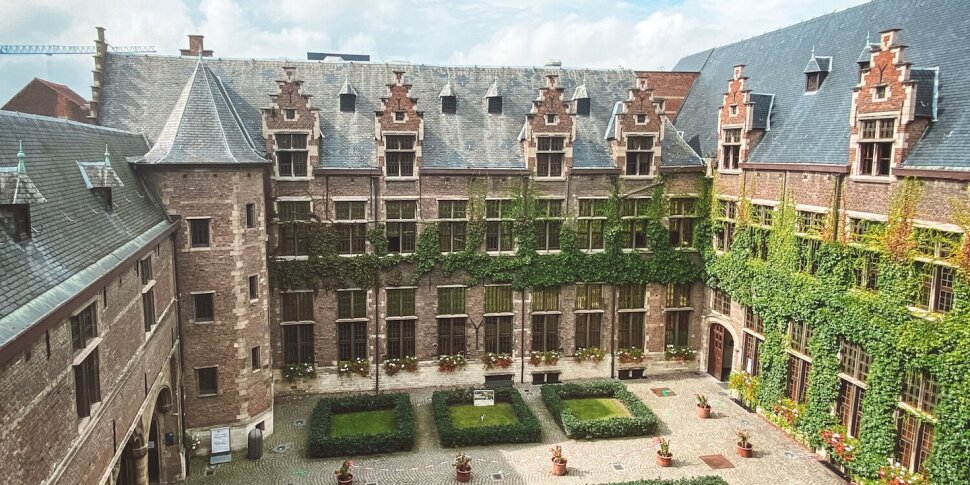
University of Antwerp, 20-22 May 2026
No sooner has the dust settled on the remarkable Beckett’s Relationships in Edinburgh than we look forward immediately to next year’s annual conference. The call for papers has just been announced and it reads as follows:
In 2026 we will be celebrating Samuel Beckett’s 120th birthday. It will also be 60 years since Julia Kristeva introduced the notion of ‘intertextuality’. Combining these anniversaries, the theme of the 11th annual conference of the Samuel Beckett Society will be ‘Beckett and Intertextuality’.
Samuel Beckett’s works are highly intertextual. Allusions abound to Dante, Shakespeare, Goethe and Proust, but also to many other literary authors, as well as cinema or the visual arts, the Bible, popular fiction, children’s literature and all kinds of general works, including biographies. Sometimes these references are playfully explicit (as in Dream of Fair to Middling Women – ‘We stole that one. Guess where.’); sometimes they are hidden, or made invisible, leaving traces only in the manuscripts.
When James Knowlson asked Beckett if the phrase ‘I call to the eye of the mind’ in Happy Days was an allusion to W. B. Yeats’s play At the Hawk’s Well, he responded: ‘they are just bits of pipe I happen to have with me’. Presenting himself as merely a ‘plumber’, Beckett claimed ignorance of the ‘history of hydraulics’. Judging from his surviving personal library, but also his reading notes and drafts, he could not lay claim to the same ignorance about literary history, the arts and other fields of knowledge.
Beckett’s writings are rich with echoes of other texts, growing fainter over time and shifting in translation. Especially when working in new media, which did not have such long histories as the more established genres of poetry, prose and theatre, Beckett often fell back on his ‘old chestnuts’ for allusions. This created a form of cross-generic or intermedial intertextuality, one in which new technological modes of expression reshaped Beckett’s work in the traditional literary forms, a practice that spans his entire career.
Beckett’s works, in their turn, are also often alluded to in contemporary art and literature, as in the ‘worstward’ way to get into a hotel room in Eimear McBride’s Strange Hotel (2020): ‘Door. Scratched dull lock. Put in. Turn the key. Fail. Joggle. Lean into. Be firm. Try again now. Try again, again. And, on another try, there. She’s in.’ As artistic forms and digital platforms continue to proliferate and evolve, the influence of Beckett’s oeuvre as a rich source of creative inspiration shows no signs of abating
The aim of the conference is therefore to invite a two-way investigation: how does Beckett’s work complicate, enrich or otherwise broaden our understanding of a key term like ‘intertextuality’ – as well as related notions such as ‘intratextuality’ – and how, in turn, does ‘intertextuality’ challenge us to think about Beckett’s work in new ways, from a historical perspective but also in the 21st century?
Eimear McBride will read from her work and give a Q&A. As a Creative Fellow at the Samuel Beckett Research Centre of the University of Reading from 2017-18, she published Mouthpieces (2021), three short texts depicting a fragmentary female experience, inspired by materials in the Beckett Archive.
The conference will also mark the 50th anniversary of the Journal of Beckett Studies and the opening of Samuel Beckett’s personal library to the public.
For the 2026 SBS conference, we invite contributions in English and in French relating to Beckett and intertextuality.
Topics might include, but are by no means limited to:
- Beckett as reader
- Intertextuality and the archive (library, reading notes, drafts)
- Letters or correspondence as source material
- Intermediality and intertextuality
- Adaptation and/as intertextuality
- Beckett’s bilingualism and intertextuality
- (Self)translation and intertextuality
- Beckett’s presence in contemporary literature
- Other creative responses to Beckett’s work
- Biography or life writing as intertextuality
- Beckett’s global cultural impact and postcolonialism
- Theoretical considerations of influence and/or intertextuality
To submit a proposal for a 20-minute academic paper please send a 200-word abstract, a 100-word bio, and any access requirements to Beckett2026@uantwerpen.be. Submissions will be open until 1 November 2025.
Applications for the SBS Ruby Cohn travel bursaries will be opened later in the year.
All participants must be members in good standing of the Samuel Beckett Society. Full details on joining or renewing here.
The full cfp in English and French can be downloaded below


